The Interpool project is a collaboration between fourteen organisations from four European countries. Together, we are exploring and testing the conditions for a pooling system for scaling up the reuse of glass packaging across national borders. The project is funded by Interreg North-West Europe.
Aims
Mapping existing systems in the Netherlands, Belgium, France and Germany.
Identifying technical, logistical, and policy bottlenecks.
Determining how to make systems work across borders.
Learning from real-world experiences of retailers, fillers, and innovators.
Delivering a shared action plan for reusable glass packaging across Europe.
-
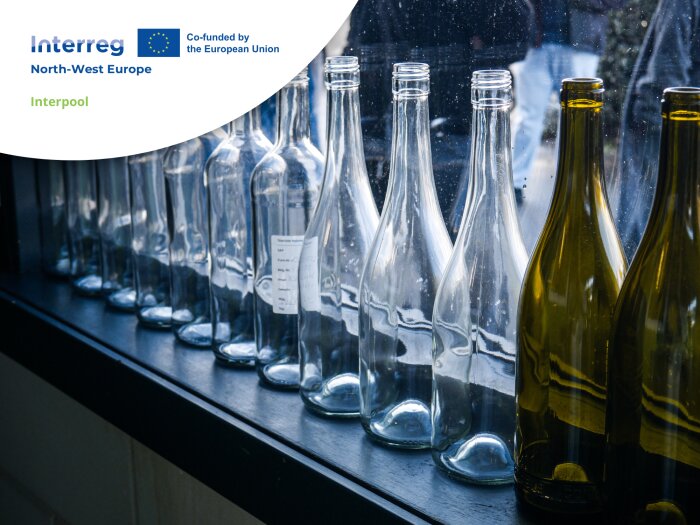 Interpool Project

Project Description
Interpool is here to unlock the untapped potential of transnational reuse of glass packaging. The project runs from January 2026 until June 2029.
Glass is very suitable to be washed, refilled and reused. While the EU’s new packaging regulations (PPWR) are driving a shift toward a circular economy, the potential of glass reuse is still trapped between national borders. Interpool is here to unlock this: through our cross-border project, we are ready to break bottlenecks instead of bottles.
We are uniting frontrunners from Northwest-Europe to harmonise solutions. Together with actors across the product’s lifecycle, we will work towards creating a pooling system in which packaging is jointly circulated, collected, cleaned, and reused, to make glass reuse more cost-effective and environmentally friendly. This shared infrastructure can reduce complexity, lower waste management costs, and increase scale across the entire region.
Currently, reuse systems follow different logics per country or industry. Reusable glass is one of the most promising pathways to reach Europe’s climate ambitions, but it only works if we collaborate. Interpool consists of a consortium of fourteen partners from Belgium, France, Germany and the Netherlands, including NGOs, producer responsibility organisations, knowledge organisations and local governments. This offers a unique opportunity to prevent fragmentation and accelerate an industry-wide transition to reuse.
From washing facilities and glass providers to supermarkets, food and beverage producers, and consumers - the entire value chain can benefit from a more accessible and effective reuse ecosystem.

Partners
