Career prospects
Meet our alumni find out where they work
Graduate outcomes
Over the past 10 years, 288 students have graduated from the Digital Business Engineering programme (including the equivalent Dutch programme). By combining technological expertise with a strong understanding of business processes, graduates are prepared for roles that require both technical and business skills.
Almost 96% of graduates find their first job within six months of graduation, reflecting the demand for professionals who can connect technology and business.
Alumni work as IT consultants, solutions architects, data engineers, product managers, and business analysts at organisations such as KPMG, Deloitte, OMP, Delaware, Accenture, Telenet, and Cegeka. Their work ranges from developing digital products and analysing data to supporting organisations in the implementation of new technologies.
What jobs can you do with a Master's in Digital Business Engineering?
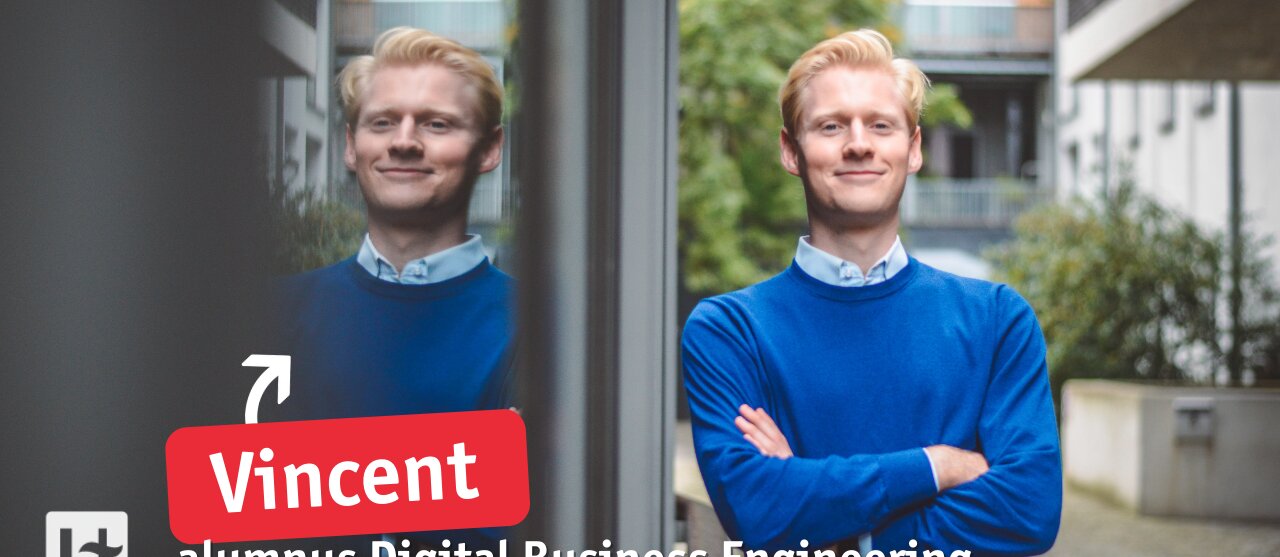
Alumnus Vincent is a Management Trainee at Proximus
Their stories
Read more about our students' experiences or ask them a question yourself.
Michiel Valee founded his own company, Dockflow

“As a start-up, Dockflow focuses on the digitalization of the logistics world using blockchain technology. Having founded the company, my range of tasks are quite diverse: I manage the business, I operate as a digital trade architect and immerse myself in logistical, IT and legal knowledge. Luckily, my degree in Digital Business Engineering prepared me to take up diverse roles. And thanks to my professors’ personal approaches, I can still turn to them now, even as a professional.”
Noémie Renaerts is Investment Banking Associate at Evercore in New York

"After obtaining my degree in Digital Business Engineering, I started working at Microsoft as a Management Trainee. In 2015, I packed up and moved to New York to work as a consultant at the Gartland and Mellina Group (GMG), a management consulting firm specializing in financial services. I worked with several financial institutions such as banks, hedge funds or insurance agencies, and gave clients advice on key challenges and strategic projects, in order to help them achieve a competitive advantage.
In August 2017, I enrolled at Harvard Business School in Boston to obtain a Master of Business Administration. I am convinced that the education I received at the UAntwerpen played an important role in my admission into the programme. Once I’ve obtained my MBA, I accepted a job offer at Evercore, an independent investment bank. Both consultants and investment bankers change projects regularly, which requires a broad set of skills and competencies. Luckily, my degree in Digital Business Engineering prepared me to adapt quickly to new topics in changing environments.
In my day-to-day tasks, I still fall back on knowledge I acquired in several management courses such as micro and macroeconomics, econometrics and financial management. But in my opinion, my biggest competitive advantage comes from my management information system courses, which, thanks to my knowledge of technology and finance, allow me to bridge an increasingly important gap between technology and C-suite problems.
So why should you choose the UAntwerp? Mainly because of the quality and flexibility of the curriculum, the smaller classes and personal connections with professors, and the many destinations for foreign exchange programmes and projects."
Kristoff Copmans is Director of Solutions Engineering at Salesforce

Why this programme?
"I was looking for a degree that combined classical business disciplines with strong quantitative, technological, and analytical components. The programme offered more than just theory; it provided a robust methodological framework. I learned to approach problems from multiple perspective, and that multidisciplinary mindset remains an essential building block of my professional identity today."
How did your career unfold after graduation?
"My journey began in London with British Telecom, working on large-scale IT transformations. I later moved to global tech giants like Oracle and Sitecore, growing from senior architecture roles into regional and global leadership positions focusing on customer experience and digital platforms.
Today, I live in Dubai and work as Director of Solutions Engineering – Enterprise Architecture & Analytics at Salesforce. I lead a team of architects guiding organizations through their data and AI transformations. My role acts as the hinge between technology, commercial strategy, and executive advisory."
International experience seems to be a common thread?
"Absolutely. It started during my studies with summer schools at Georgetown University and in Beijing, which shaped my views on the global economy. Since graduating, I have lived in the UK and the UAE, managing projects in over 60 countries. What began as an academic path in Antwerp grew into a truly global career. The multilingualism and cultural adaptability I developed during my studies continue to open doors worldwide."
Which skills do you still use today?
"While courses like System Design and Strategic Management were key, the most valuable takeaway was intellectual discipline. The ability to structure, prioritize, abstract, and communicate complex ideas is timeless. In a fast-evolving tech landscape, these skills are more critical than ever."
What's your nr. 1 tip for current students?
"View your career as a continuous learning process, not a fixed path. Invest in a strong analytical foundation, but remain curious and open to the unexpected. In a world driven by technology and AI, human skills like communication, empathy, and integrity will make the difference. The University of Antwerp offers the perfect strong foundation to build that future."
My biggest competitive advantage comes from my management information system courses.