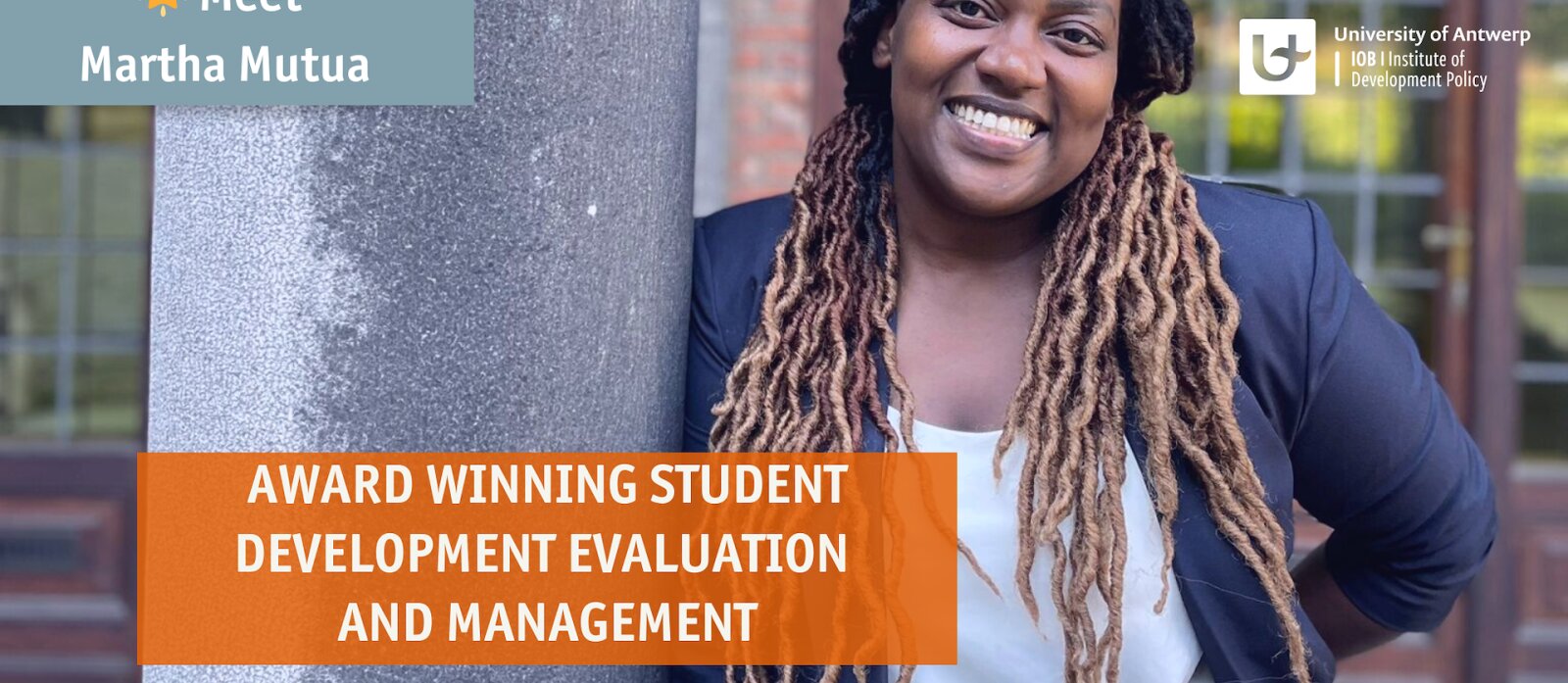
🌟 Meet Martha Mutua
- Are you a current or aspiring monitoring and evaluation (M&E) practitioner or researcher looking to complement your practical skills with deeper theoretical knowledge?
- Do you want to sharpen your understanding of the past and present aid policies of multilateral and bilateral donors, and learn how to critically analyze the major aid modalities and instruments deployed by these actors?
In the Advanced Master of Development Evaluation and Management at the University of Antwerp’s Institute of Development Policy (IOB), you’ll assess the strengths and weaknesses of prevailing development paradigms and gain insights on different actors and institutions, from the local to the international level. You will be equipped with multidisciplinary analytical tools that will enable you to confidently conduct academic research on development policies and programmes using qualitative, quantitative, or mixed methods. Electives offered in this programme address some of the most pressing issues in contemporary development practice, including natural resources, migration, gender and development, land access and tenure, climate finance and the ‘greening’ of aid, and access to public goods and services.
Programme overview
Theories of Development

This course introduces the major political, cultural and economic perspectives shaping development thinking. Students examine how politics and power, culture and agency, institutions and markets, and concepts such as poverty, inequality and well-being influence development trajectories. Across four thematic units, you gain a multidimensional, critical and decolonial understanding of development and its determinants.
Research Methods I
Research Methods I provides the foundations of knowledge production in development studies. Students explore key research paradigms, learn to critically read and assess academic work, and reflect on ethics and positionality. The second half of the course focuses on research design, introducing both quantitative and qualitative approaches, sampling strategies, measurement, and questions of validity and reliability.
Evaluating Development effectiveness
This course trains students to design, conduct, and critically evaluate development interventions. Starting with the principles of development effectiveness, students learn the foundations of monitoring and evaluation (M&E) and explore its organizational, political, and ethical dimensions. They can then specialize in qualitative and transformative evaluation, quantitative impact assessment, or political economy analysis, gaining hands-on experience through Action Labs that include case studies, surveys, interviews, and data analysis. By the end of the course, students are equipped to produce rigorous, socially aware, and context-sensitive evaluations, preparing them for careers as development evaluators, policy analysts, program managers, or researchers who can turn evidence into impactful decision-making in diverse development contexts.
Track 1: Local Institutions, Structure & Agency
Focusing on the local level, this course explores how everyday institutions, norms, power relations and collective action influence development processes. Topics include gender, local governance, migration, community-driven initiatives and citizen-led accountability. Field-based components—such as community monitoring in Tanzania or the Justice Co-Laboratory in Antwerp—allow students to apply concepts in real contexts.
Track 2: (Inter)national Institutions and Global Public Goods
Explore how aid, global public goods, and monitoring and evaluation shape development outcomes worldwide. Gain practical skills to design and assess M&E systems, engage with governance, sustainability, or gender issues, and critically analyse real-world challenges. Apply your knowledge in an end-of-module paper, building a strong foundation for impactful careers in global development.
Research Methods II
Research Methods II offers applied, hands-on training through a modular set of quantitative and qualitative units. Options include data handling, descriptive statistics, regression and causal inference; qualitative interviewing and fieldwork design; discourse analysis; NVivo-based data analysis; and transformative methodologies such as participatory, feminist and decolonial approaches. An optional research stay in Tanzania or the DR Congo provides immersive field experience within ongoing research projects.
Master Dissertation
The programme concludes with a written dissertation, defended orally, allowing students to apply theoretical and methodological skills to a governance and development issue of their choice.
Examples of topics studied
- Evaluating the effectiveness of foreign aid programs (e.g., impact of USAID projects in Ethiopia).
- The role of NGOs in poverty alleviation (e.g., microfinance programs in India).
- Assessing healthcare interventions in developing countries (e.g., malaria prevention in Ghana).
- Measuring the success of gender equality initiatives (e.g., women’s empowerment programs in Afghanistan).
- Using qualitative and quantitative research methods to assess development projects.
Real-world applications
- Monitoring & Evaluation (M&E) Specialist → Assessing the impact of development programs and improving effectiveness.
- Development Consultant → Advising governments and NGOs on best practices in program design.
- Impact Analyst in an NGO or International Organization → Measuring project outcomes and ensuring accountability.
Example career path
A graduate might work at the World Bank, evaluating the success of agricultural development projects in Sub-Saharan Africa to ensure that funding is used effectively.
2026-2027
Model Path
Compulsory courses
30 ECTS-credits
Theories of development
Research Methods I
Research Methods II
Evaluating development effectiveness
Elective courses
Choose one of the courses - 12 ECTS-credits
Local institutions, structure and agency
(Inter-)national institutions and global public goods
Master Dissertation
18 ECTS-credits
Dissertation
2025-2026
Model Path
Module I
Theories of development
Research Methods I
Research Methods II
Module II
Evaluating development effectiveness
Module III
Choose one of the modules
Local institutions, structure and agency
(Inter-)national institutions and global public goods
Module IV
Dissertation
2024-2025
Model Path
Module I
Theories of development
Research Methods I
Research Methods II
Module II
Evaluating development effectiveness
Module III
Choose one of the modules
Local institutions and poverty reduction
National Institutions, Poverty Reduction Strategies and Aid
Module IV
Dissertation
2023-2024
Model Path
Module I
Theories of development
Research Methods I
Research Methods II
Module II
Evaluating development effectiveness
Module III
Choose one of the modules
Local institutions and poverty reduction
National Institutions, Poverty Reduction Strategies and Aid
Module IV
Dissertation
2022-2023
Model Path
Module I
Theories of development
Research Methods I
- Tom De Herdt
- Christian Kamala Kaghoma
- Pierre Merlet
- Nik Stoop
- Kristof Titeca
- Diana Tiholaz
- Hanne Van Cappellen
- Frank van Splunder
- Juan Sebastian Velez Triana
- Cassandra Vet
Research Methods II
- Kristof Titeca
- Tom De Herdt
- Sara Geenen
- Nathalie Holvoet
- Christian Kamala Kaghoma
- Bossissi Nkuba
- Sarah Vancluysen
- Stef Vandeginste
- Gert Van Hecken
- Catherine Windey
- Ivan Ashaba
- Alder Contreras Hernández
- Stephanie Garcidueñas Nieto
- Mark Marvin Kadigo
- Denis Augustin Samnick
Module II
Evaluating development effectiveness
Module III
Choose one of the modules
Local institutions and poverty reduction
- Tom De Herdt
- Sara Geenen
- Nathalie Holvoet
- Sarah Katz-Lavigne
- Vijay Krishnan Kolinjivadi
- Pierre Merlet
- Stylianos Moshonas
- Fergus Simpson
- Kristof Titeca
- Sarah Vancluysen
- Catherine Windey
- Alder Contreras Hernández
- Denis Augustin Samnick
- Alellie Sobreviñas
National Institutions, Poverty Reduction Strategies and Aid
Module IV
Dissertation
2021-2022
Model Path
Module I
Theories of development
Research Methods I
- Bert Ingelaere
- Nik Stoop
- Kristof Titeca
- Diana Tiholaz
- Hanne Van Cappellen
- Frank van Splunder
- Juan Sebastian Velez Triana
- Cassandra Vet
Research Methods II
- Kristof Titeca
- Sara Geenen
- Nathalie Holvoet
- Brototi Roy
- Stef Vandeginste
- Catherine Windey
- Ivan Ashaba
- Alder Contreras Hernández
- Stephanie Garcidueñas Nieto
- Mark Marvin Kadigo
- Réginas Ndayiragije
- Denis Augustin Samnick
- Hanne Van Cappellen
- Sarah Vancluysen
- Juan Sebastian Velez Triana
- Cassandra Vet
Module II
Evaluating development effectiveness
Module III
Choose one of the modules
Local institutions and poverty reduction
- Tom De Herdt
- Johan Bastiaensen
- Sara Geenen
- Nathalie Holvoet
- Frédéric Huybrechs
- Sarah Katz-Lavigne
- Vijay Krishnan Kolinjivadi
- Stylianos Moshonas
- Kristof Titeca
- Sarah Vancluysen
- Catherine Windey
- Alder Contreras Hernández
- Denis Augustin Samnick
- Alellie Sobreviñas
National Institutions, Poverty Reduction Strategies and Aid
Module IV
Dissertation
- Stef Vandeginste
- Johan Bastiaensen
- Danny Cassimon
- Tom De Herdt
- Sara Geenen
- Nathalie Holvoet
- Bert Ingelaere
- Vijay Krishnan Kolinjivadi
- George Mavrotas
- Nadia Molenaers
- Brototi Roy
- Nik Stoop
- Kristof Titeca
- Sarah Vancluysen
- Gert Van Hecken
- Marijke Verpoorten
- Catherine Windey
- Denis Augustin Samnick
2020-2021
Model Path
Module I
Theories of development
Research Methods I
- Bert Ingelaere
- Nik Stoop
- Kristof Titeca
- Hanne Van Cappellen
- Frank van Splunder
- Juan Sebastian Velez Triana
- Cassandra Vet
Research Methods II
- Kristof Titeca
- Johan Bastiaensen
- Sara Geenen
- Nathalie Holvoet
- Bert Ingelaere
- Stef Vandeginste
- Sahawal Alidou
- Ivan Ashaba
- Mark Marvin Kadigo
- Réginas Ndayiragije
- Denis Augustin Samnick
- Hanne Van Cappellen
- Sarah Vancluysen
- Juan Sebastian Velez Triana
- Cassandra Vet
- Catherine Windey
Module II
Evaluating development effectiveness
- Nathalie Holvoet
- Joachim De Weerdt
- Nadia Molenaers
- Gert Van Hecken
- Mark Marvin Kadigo
- Nik Stoop
Module III
Choose one of the modules
Local institutions and poverty reduction
- Tom De Herdt
- Johan Bastiaensen
- Milena Belloni
- Sara Geenen
- Nathalie Holvoet
- Frédéric Huybrechs
- Sarah Katz-Lavigne
- Vijay Krishnan Kolinjivadi
- Stylianos Moshonas
- Kristof Titeca
- Catherine Windey
- Denis Augustin Samnick
- Alellie Sobreviñas
- Sarah Vancluysen
National Institutions, Poverty Reduction Strategies and Aid
Module IV
Dissertation
2019-2020
Model Path
Module I
Theories of development
Research Methods I
- Bert Ingelaere
- Jean-Francois Maystadt
- Kristof Titeca
- Mollie Gleiberman
- Hanne Van Cappellen
- Sarah Vancluysen
- Frank van Splunder
- Juan Sebastian Velez Triana
- Cassandra Vet
Research Methods II
- Johan Bastiaensen
- Jean-Francois Maystadt
- Kristof Titeca
- Sara Geenen
- Nathalie Holvoet
- Bert Ingelaere
- Stef Vandeginste
- Sahawal Alidou
- Ivan Ashaba
- Mollie Gleiberman
- Réginas Ndayiragije
- Lisa Popelier
- Denis Augustin Samnick
- Hanne Van Cappellen
- Sarah Vancluysen
- Juan Sebastian Velez Triana
- Cassandra Vet
- Catherine Windey
Module II
Evaluating development effectiveness
- Nathalie Holvoet
- Joachim De Weerdt
- Nadia Molenaers
- Gert Van Hecken
- Lisa Popelier
- Nik Stoop
Module III
Choose one of the modules
Local institutions and poverty reduction
- Tom De Herdt
- Johan Bastiaensen
- Sara Geenen
- Nathalie Holvoet
- Jean-Francois Maystadt
- Kristof Titeca
- Vijay Krishnan Kolinjivadi
- Denis Augustin Samnick
- Alellie Sobreviñas
- Sarah Vancluysen
National Institutions, Poverty Reduction Strategies and Aid
Module IV
Dissertation
- Stef Vandeginste
- Johan Bastiaensen
- Danny Cassimon
- Joachim De Weerdt
- Sara Geenen
- Nathalie Holvoet
- Bert Ingelaere
- Els Lecoutere
- Jean-Francois Maystadt
- Nadia Molenaers
- Kristof Titeca
- Gert Van Hecken
- Marijke Verpoorten
- Mollie Gleiberman