At the University of Antwerp, there is a mandatory reporting obligation for all defence-related research.
Defence-related research includes any research in which a national or international defence body is directly or indirectly involved as a client, funding agency, partner and/or end user.
This includes, for example, projects in collaboration with or funded by the Royal Higher Institute for Defence (RHID), the European Defence Fund (EDF), or NATO’s Defence Innovation Accelerator for the North Atlantic (DIANA).
Bilateral collaborations with companies may also be defence-related.
Such research activities have links to military applications or security-related issues.
Concepts frequently encountered in the context of defence-related research are dual-use research and military research.
Dual Use
Dual-use research refers to research on “goods and technologies that can be used for both civilian and military purposes. […] In the case of dual-use technologies, these are technologies that have a civilian application, but that—after potential further R&D—can also be used in or for conventional military systems.”
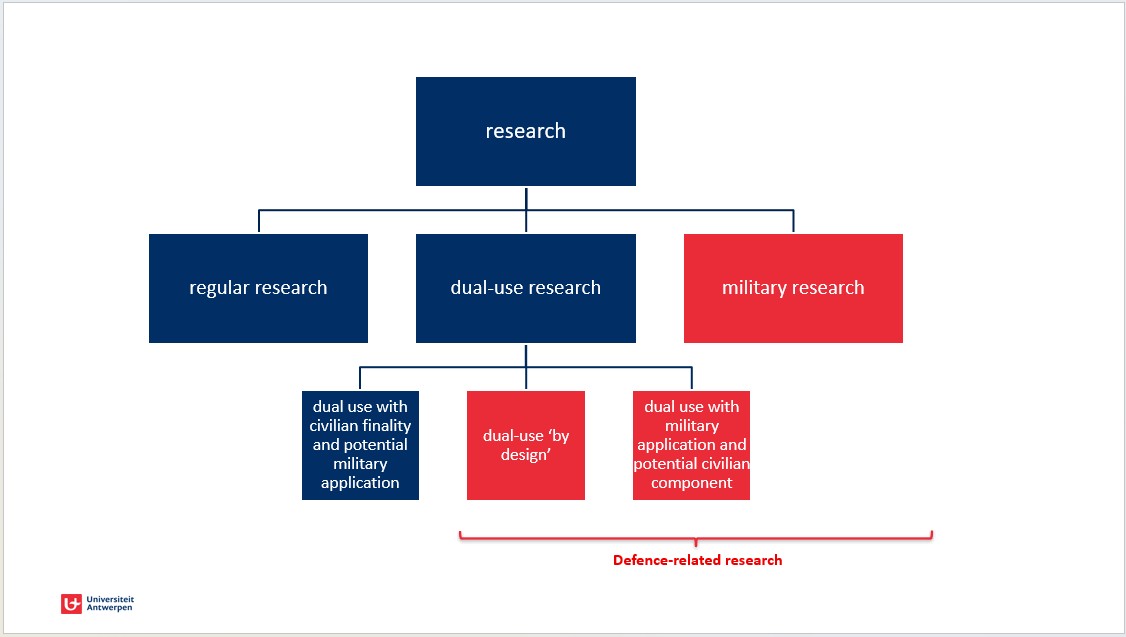
Within dual-use research, there has been a growing shift from initially civilian-oriented research with potential military application, to dual-use research by design, and increasingly towards research with a predominantly military application but also a possible civilian component. Dual-use by design or dual military-civil research can therefore also be classified as defence-related research: research with an intended military application and a civilian component.
“Dual-use products” form a specific, legally defined category of strategic goods that are used in the civilian industry but may also have a military destination. The items (goods, materials, technologies, software, and technical knowledge) classified as dual use are listed in Annex I of the European Dual-Use Regulation (EU) No. 2021/821. This classification is therefore objective and not a matter of subjective interpretation.
Research with a dual or military objective is subject to a complex interaction of legal and ethical obligations that do not necessarily fully overlap. For example, research that raises no particular ethical concerns may still be subject to legal obligations regarding the export of dual use technology. Conversely, a research institution may impose ethical controls that go beyond the export controls arising from legislation.
More information can be found in the VLIR guidelines for researchers on dual use and misuse of research.
Military Research
Military research is research aimed exclusively at military end use. Military research at higher technology readiness levels (TRLs) is typically conducted within defence research laboratories themselves (e.g. ballistic laboratories of the Belgian armed forces or NATO test sites).
The figure below schematically represents everything that falls under defence-related research.
At the University of Antwerp, defence-related research is conducted only when there are potential civilian applications. We attach great importance to the university’s societal responsibility and deploy our various areas of expertise to promote a broad approach to security and peace. Inter-university and international collaboration is also an important consideration. Naturally, defence-related research at our university must comply with all applicable laws and regulations.
Misuse
Misuse refers to the use of research or research results for unethical purposes. The focus is primarily on misuse for terrorist or criminal activities, as well as applications that can (or may) be used to violate human rights or compromise the safety of people, animals, or the environment. As a researcher, you may conduct your research with the best intentions, but this does not preclude the possibility that it may be used differently in the wrong hands.
In defence-related research, the risk of misuse is inherently higher due to the dual nature of the research design. Extra attention to security, ethical reflection, and human rights is therefore strongly recommended.
Reporting obligation
All defence-related research projects are screened by the MiHRS Committee (EC MiHRS). The EC MiHRS issues advice on knowledge security, dual use, and human rights, thereby supporting a responsible research practice within the university. All applications are consistently assessed against the framework agreed upon between the Flemish universities (cf. VLIR guidelines on knowledge security, dual use, and misuse of research). When calls for defence-related research are disseminated, the requirement to obtain an opinion from the EC MiHRS is explicitly stated.
Applications submitted to the EC MiHRS may only commence after receipt of a positive opinion.